
 By Dgmnews Team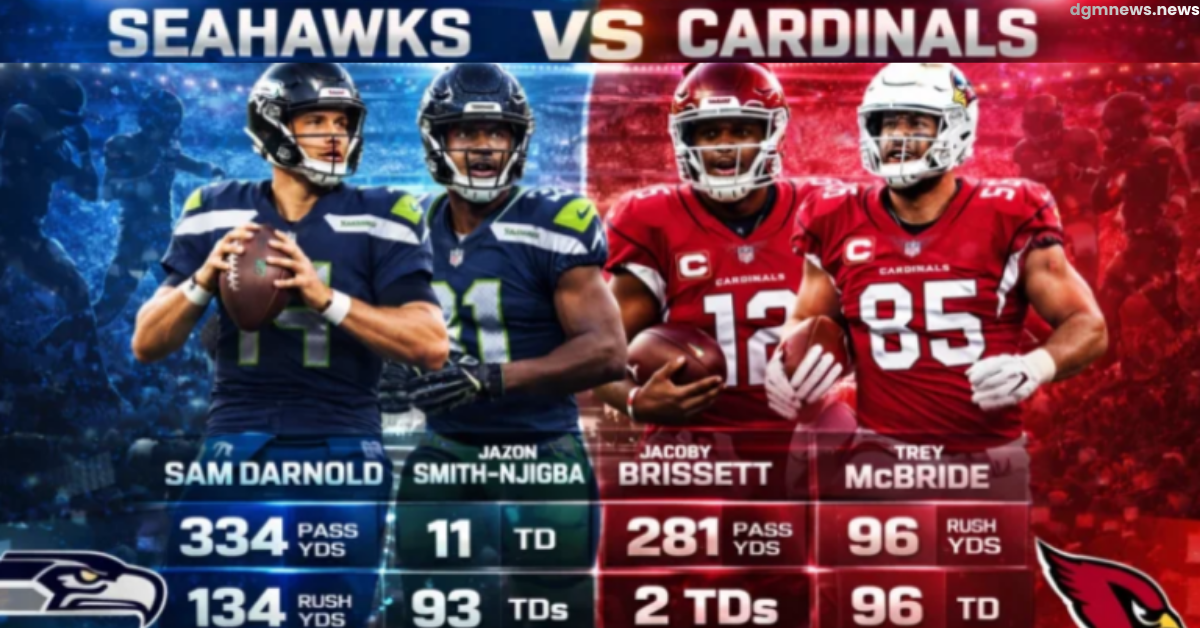
Introduction
Have you ever watched a division rivalry game and feel like every single play matters triple? That’s exactly what happened when the Seahawks and Cardinals threw down recently. The Seahawks vs Arizona Cardinals match player stats from this NFC West battle tell you everything about who wanted it more and who actually delivered when the pressure was on.
Division games hit different men. These teams know each other inside and out. They’ve studied film til their eyes hurt, they know tendencies, they know weaknesses. There’s nowhere to hide when you’re facing a division opponent twice every single year.
Stats aren’t just boring numbers someone puts on a spreadsheet. They’re the actual story of what went down between those white lines. Who moved the ball when it counted? Which defense actually got stops on third down? Did turnovers decide everything or was it something else?
Look, whether you’re rocking Seahawks gear celebrating another W, wearing Cardinals red trying to figure out what went sideways, or just someone who geeks out over football analytics – we’re breaking down every meaningful stat that shaped this game’s outcome from the opening snap through the final whistle.
Pre-Game Buzz and What Everyone Expected
Walking into this matchup, people had opinions. The Seahawks vs Arizona Cardinals match player stats would eventually show who was right and who was talking out of their backside.
Seattle came in riding some momentum. Their offense had been cooking lately – running game working, passing game clicking, everything looking balanced. Defense needed to prove something though, especially against Arizona’s playmakers who can burn you quick.
Arizona? They were scrapping for respect after a tough stretch. Their young signal caller had these moments where he looked like a future star mixed with plays where you’re like “what was that?” The Cardinals defense needed a big performance to show they could hang with better teams.
Weather wasn’t gonna be an excuse for anybody. Perfect football conditions at kickoff. No rain, no crazy wind, temperatures right where quarterbacks like them. Both offenses would have to actually execute without blaming Mother Nature.
The injury situation looked decent for both squads. Nobody was missing their franchise quarterback or anything devastating like that. Depth might get tested if someone went down, but going in? Both teams had their guys.
Vegas had Seattle favored but not by much. The spread suggested this could go either way depending on who showed up. Turns out the bookmakers weren’t too far off based on how competitive things got.
First Half Action and How Points Got Scored
The opening quarter showed what Seahawks vs Arizona Cardinals match player stats would look like once everything was tallied. Both defenses came out fired up, stuffing early drives and forcing punts.
Seattle punched first with this beautiful drive that ate up like seven minutes. Their running back hit holes perfectly, the quarterback made smart throws on third down, just methodical football. The touchdown came on play action where their tight end was wide open because Arizona bit hard on the fake.
The Cardinals didn’t panic though. They fired right back with this explosive drive that had Seahawks fans nervous. Big chunk plays, their receiver making ridiculous catches in traffic. Tied it up quickly with a touchdown that showed they weren’t backing down.
The second quarter turned into a defensive slugfest. Both coordinators made adjustments after giving up those opening scores. Pass rush picked up intensity, coverage got tighter, running lanes disappeared. This was trench warfare football.
Seattle squeezed out a field goal right before halftime after their drive stalled in the red zone. Settling for three instead of seven felt disappointing but those points ended up mattering way more than anyone knew watching live.
The halftime score kept things tight with Seattle up by a field goal. Nobody had grabbed control yet. The Seahawks vs Arizona Cardinals match player stats at the break showed two evenly matched teams scrapping for every single yard.
Quarterback Battle and Air Attack Numbers
Quarterbacks run the show, period. The Seahawks vs Arizona Cardinals match player stats at this position showed who handled adversity better and made fewer brain-dead decisions.
Seattle’s quarterback played smart, mature football. He wasn’t trying to be a hero on every throw. When nothing was there, he took his checkdown or tossed it away and lived for the next snap. His completion percentage stayed in that sweet spot around sixty-five percent showing consistency.
His deep ball was money all afternoon. Multiple shots downfield over twenty yards that stretched Arizona’s defense thin. When their safeties started cheating up to help against the run, boom – he’d launch one over their heads and make them pay.
Arizona’s quarterback has this cannon arm that scouts absolutely drool over. The kid can make throws that most quarterbacks physically can’t even attempt. Velocity, weird arm angles, fitting balls into tight windows – the physical tools are legit unreal.
But man, consistency killed him. For every throw that made you jump off the couch, there’d be one where you’re scratching your head wondering what he saw. Reading defenses before the snap and going through progressions after? Still needs major work there.
Pressure rattled both guys differently. Seattle’s veteran stayed composed when the pocket collapsed, finding his outlet or protecting the ball by throwing it away. Arizona’s younger guy sometimes held onto it way too long trying to create magic that wasn’t happening.
Touchdown to pick ratio wasn’t even close. Seattle’s quarterback tossed two scores without a single interception. Arizona threw one touchdown but also gave Seattle an interception in the red zone that absolutely killed their momentum.
Running Game Showdown and Yards on the Ground
Establishing the run game sets the tone physically. The Seahawks vs Arizona Cardinals match player stats on the ground proved which offensive line actually won their one-on-one battles consistently.
Seattle’s rushing attack basically controlled the entire game’s tempo. Their main back touched the ball over twenty times and ran with ridiculous patience. He’d wait for blocks to develop, hit the cutback lane, and avoid stupid negative plays. That’s veteran running back stuff right there.
His pass blocking deserves props too. Multiple times Arizona sent extra rushers and he absolutely stonewalled linebackers coming free. Running backs who can pass protect stay on the field all three downs, making them crazy valuable.
Arizona couldn’t get anything going on the ground whatsoever. Their running back kept facing stacked boxes because Seattle didn’t respect the passing attack enough to back their safeties off. Hard to run when eight guys are in the box.
Yards per carry numbers tell you everything you need to know. Seattle averaged over four yards every single rush while Arizona couldn’t even sniff three yards per attempt. That efficiency gap over four quarters turns into massive differences in total yardage and clock control.
Seattle’s offensive line absolutely dominated up front. They created actual running lanes and sustained blocks long enough for their back to reach the second level regularly. Arizona’s offensive line? They got pushed around more than they’d ever admit publicly.
Short yardage situations exposed the rushing gap completely. Seattle converted basically every third and short or fourth and short. Arizona failed several crucial short yardage conversions which forced punts and murdered promising drives.
Check out more comprehensive game coverage breaking down every matchup throughout the season.
Pass Catchers and Reception Statistics
Receivers make offenses dangerous. Looking at Seahawks vs Arizona Cardinals match player stats for pass catchers shows who created separation and hauled in tough catches when stakes were highest.
Seattle’s top receiver absolutely cooked his matchups all game long. Eight grabs for over ninety yards plus a touchdown. He consistently won at the line of scrimmage and manufactured space even against press coverage.
The tight end became this automatic safety valve the whole afternoon. Six catches on seven targets screams quarterback trust in crucial moments. His knack for finding soft spots in zone coverage moved chains repeatedly when Seattle needed it most.
Arizona’s rookie receiver flashed why they burned a first rounder on him. A couple spectacular grabs showcased legitimate NFL hands and body control. But inconsistency bit him with a dropped pass on third down that would’ve kept their drive breathing.
Seattle’s slot guy did serious damage underneath all game. Quick hitters, option routes against zone, making the first guy miss after the catch. Those ten to fifteen yard pickups compound significantly over sixty minutes.
Arizona’s tight end barely got targeted compared to expectations. Seattle clearly schemed to eliminate him as a receiving threat, forcing the Cardinals to lean on less proven guys in the aerial attack.
Yards after catch became absolutely decisive. Seattle receivers consistently broke tackles and picked up chunks after making grabs. Arizona’s pass catchers got wrapped up almost immediately, killing any explosive play potential.
Defensive Monsters and Who Made Plays
Defense creates scoring chances for your offense. The Seahawks vs Arizona Cardinals match player stats on the defensive side revealed which unit controlled the trenches and forced those game-changing turnovers.
Seattle’s edge rusher went absolutely nuclear. Two sacks, constant quarterback hits, nonstop pressure that wrecked Arizona’s timing the entire afternoon. When edge guys dominate like that, it forces offensive coordinators to completely redesign their game plan.
The linebacker group for Seattle played fundamentally sound football. Gap assignments stayed tight against runs, coverage responsibilities got handled in the passing game. That boring fundamental soundness prevented Arizona from ever finding any offensive rhythm.
Arizona’s defensive line battled hard despite losing. Their interior tackle clogged running lanes occasionally and sometimes pushed the pocket back into Seattle’s quarterback’s lap. Winning some individual battles while losing the war overall.
Seattle’s corner shadowed Arizona’s number one receiver basically the entire game. Physical coverage at the line, tight hip coverage downfield, excellent awareness on fifty-fifty balls. That’s legit shutdown cornerback play.
The safety position made probably the biggest difference though. Seattle’s free safety read Arizona’s young quarterback like a book, jumping routes and nearly picking off multiple passes. His presence over the top completely eliminated deep shot attempts.
Tackle numbers favored Seattle just because Arizona ran way more offensive plays. Time of possession advantages meant more chances for Seahawks defenders to pile up stats.
Special Teams and Field Position Wars
Special teams decide tight games through field position battles. The Seahawks vs Arizona Cardinals match player stats in this phase showed solid execution with several key moments swinging things.
Seattle’s punter had a legitimately strong day pinning Arizona deep repeatedly. His hang time gave coverage teams forever to get downfield and limit returns. Quality punting complements strong defense by burying offenses in terrible field position.
Arizona’s kicker stayed perfect on his limited chances. Nailed his only field goal try and all the extra points. Having that reliability from your kicker lets coaches stay aggressive in questionable situations.
Kickoff coverage stayed strong for both squads. No explosive returns flipped field position dramatically. Coverage units tackled quickly and consistently forced opponents to start drives inside their own twenty-five.
Seattle pulled off a successful fake field goal that caught Arizona sleeping completely. The holder rolled out and found the tight end for a first down extending a scoring drive. Those trick plays energize your entire sideline instantly.
Punt returns produced basically nothing for either team. Fair catches outnumbered actual returns by a huge margin. Neither return guy found running room when they actually did get opportunities.
Field position battle tilted slightly toward Seattle overall. Their average starting spot was around their own thirty-two. Arizona averaged starting near their own twenty-seven, which is a five-yard difference that legitimately impacts play calling options.
Game-Changing Turnovers and Momentum Swings
Turnovers flip games instantly. Breaking down Seahawks vs Arizona Cardinals match player stats means spotting those critical mistakes that shifted momentum permanently.
Arizona’s red zone pick was absolutely soul-crushing. Driving for a potential go-ahead score, their quarterback forced a throw into double coverage trying to make something happen. Seattle’s safety made the easy interception, completely killing all Cardinals momentum right there.
Seattle protected the rock beautifully all sixty minutes. Zero turnovers through the entire game screams discipline and intelligent decision-making from every single player. You rarely lose when you dominate the turnover battle completely.
A fumble by Arizona in the third quarter basically sealed their fate. Already trailing, they absolutely couldn’t afford handing Seattle short field position. The Seahawks scored a touchdown immediately after, making the deficit way too big to overcome.
Fourth down conversions turned into mini-momentum shifters throughout. Seattle converted two massive fourth downs that kept scoring drives alive. Arizona failed both their fourth down tries, swinging field position and sideline energy dramatically.
Big plays swung momentum back and forth repeatedly. Seattle’s forty-yard bomb down the sideline flipped field position instantly and led straight to points. Arizona couldn’t answer with explosive plays when they desperately needed them most.
Coaching Chess Match and Strategic Adjustments
Coaching decisions massively affected Seahawks vs Arizona Cardinals match player stats beyond just players executing on the field.
Seattle’s head coach managed the game conservatively once they grabbed a lead. Run the ball, milk the clock, force Arizona to drive ninety yards multiple times. That time-tested formula crushes less experienced opponents.
Arizona’s staff tried staying aggressive despite trailing. Fourth down gambles showed willingness to take risks, but execution failed when it mattered absolutely most.
Halftime changes heavily favored Seattle defensively. They identified tendencies in Arizona’s pass game and adjusted coverage schemes accordingly. Second half passing yards for the Cardinals dropped dramatically after those tweaks.
Clock management hurt Arizona badly late in the game. Poor time management and burning timeouts stupidly cost them potential scoring chances when they desperately needed every single tick.
Seattle’s defensive coordinator called a brilliant game overall. Disguising coverages confused Arizona’s quarterback constantly. Pressure packages hit perfectly timed on crucial downs.
For more in-depth football analysis covering coaching strategies and game breakdowns, stay connected throughout the season.
Injuries and Physical Availability Impact
Injuries change outcomes more than casual fans understand. The Seahawks vs Arizona Cardinals match player stats got influenced heavily by who was available and who was compromised physically.
Both teams entered fairly healthy with core starters suiting up. No major injury drama dominated pregame discussions. Full rosters gave coaching staff their complete playbooks without needing emergency adjustments.
During the game, an Arizona offensive lineman limped off with what looked like a leg injury. Backup performance dropped noticeably afterward. Pass protection got worse and running lanes shrank after that substitution.
Seattle avoided major injuries throughout this physical division battle. Staying healthy matters tremendously as seasons grind toward playoff races where depth gets tested repeatedly.
Arizona’s top receiver played through what seemed like a minor injury. His production fell off noticeably in the second half, suggesting something was definitely bothering him even though he stayed out there.
Depth differences showed clearly when reserves entered the game. Seattle’s backups stepped in seamlessly and production barely dropped. Arizona’s depth wasn’t nearly as reliable when starters needed breathers or couldn’t continue.
Division Rivalry History Between These Teams
Understanding Seahawks vs Arizona Cardinals match player stats requires knowing the broader rivalry context these NFC West foes share.
These division rivals have scrapped twice every year for decades now. Series history tilts slightly toward Seattle with more overall wins, though Arizona’s had stretches where they dominated this matchup.
Recent meetings have mostly gone Seattle’s direction. The Seahawks won several straight before this latest clash, establishing themselves as the team controlling this particular rivalry currently.
Memorable games absolutely define this rivalry. Overtime classics, playoff seeding decided in regular season finales, individual performances that became franchise legend. Both fanbases remember those moments crystal clear.
Current rosters don’t feature many guys who’ve been part of this rivalry long-term. Roster turnover means fewer personal grudges between individual players meeting repeatedly across multiple seasons.
Coaching approaches differ between these organizations right now. Seattle operates with veteran coaching stability while Arizona works with newer leadership still building their system and identity.
What This All Means Moving Forward
The Seahawks vs Arizona Cardinals match player stats reveal crucial information about both franchises’ trajectories pushing through the season.
Seattle proved they’re legitimate playoff material. Balanced offense, opportunistic defense, intelligent coaching, disciplined execution – those traits separate contenders from pretenders consistently.
Arizona’s rebuilding process continues with expected growing pains along the way. Young players gaining reps against quality division opponents builds foundation even when wins don’t immediately pile up.
For Cardinals supporters, certain young guys flashed ability suggesting brighter days ahead. Development takes patience and time, especially with young quarterbacks learning the NFL game’s insane complexity.
Seattle fine-tuned execution rather than learning basic lessons. Teams at their level focus on perfecting details and maintaining health for playoff pushes in the season’s final stretch.
Both organizations extract completely different lessons from this division showdown. Seattle keeps grinding for playoff seeding while Arizona continues developing young talent for future competitive windows.
Conclusion
The Seahawks vs Arizona Cardinals match player stats paint a clear picture. Seattle dominated most categories, controlled clock decisively, won the turnover battle cleanly, and executed better when games hung in the balance.
Arizona showed guts and some legitimately promising young talent but couldn’t overcome Seattle’s experience edge and superior execution. That’s expected when rebuilding squads face established playoff contenders.
Stats from division clashes like this spotlight areas demanding immediate improvement. Where does Arizona need roster upgrades desperately? What weaknesses got repeatedly exposed? How do young players bounce back after getting outplayed by veterans?
Seattle validated their playoff aspirations completely. Every phase displayed professionalism and championship-caliber execution. That’s what contending teams look like when everything clicks properly.
The numbers painted the full picture. Now both teams roll forward – one hunting playoff seeding, one continuing development of young talent for future competitive seasons ahead.
FAQs
Who led all rushers in the Seahawks vs Cardinals game?
Seattle’s running back absolutely dominated with well over one hundred yards rushing, consistently hitting holes and gaining extra yardage through contact throughout all four quarters of action.
How many interceptions occurred in the Seahawks vs Cardinals matchup?
Arizona’s quarterback threw one devastating interception inside the red zone while Seattle’s signal caller protected the football perfectly, avoiding turnovers and managing the game situation intelligently.
Which player recorded the most receiving yards?
Seattle’s number one receiver dominated completely with over ninety receiving yards on eight receptions, consistently winning his matchups and manufacturing separation against Arizona’s secondary coverage.
What was the turnover differential in the game?
The turnover battle heavily favored Seattle at plus-two overall, with Arizona committing two costly turnovers while the Seahawks maintained absolutely perfect ball security from kickoff through the final whistle.
How many sacks did Seattle’s defense record?
The Seahawks defensive line recorded multiple sacks with their edge rusher leading the charge, constantly pressuring Arizona’s quarterback and disrupting offensive timing throughout the entire contest.
Did weather impact the Seahawks vs Cardinals game?
Weather conditions were absolutely ideal with zero wind and comfortable temperatures, creating perfect passing conditions that completely eliminated weather as any kind of factor for either offense.
Who scored first in the Seahawks vs Cardinals matchup?
Seattle scored first on a methodical touchdown drive that established offensive rhythm early, though Arizona responded quickly with their own scoring drive to immediately tie things up.
What was the final score of Seahawks vs Cardinals?
Seattle won comfortably when everything was said and done, with the final score accurately reflecting their dominance across most statistical categories and superior execution during all critical game moments.